Skin changes after laser treatment are a natural process reflecting the effect of the procedure. Because laser treatment is a therapy that deliberately stimulates skin tissue to induce regeneration and recovery, various skin changes appear from immediately after the procedure over several weeks. This article organizes the expected skin changes after laser treatment over time and presents care methods and precautions at each stage. Depending on the type and intensity of the laser treatment, the degree of change may vary by individual.
Working Principle of Laser Treatment and Initial Skin Response

Laser treatment is a procedure that irradiates the skin with high-energy light to stimulate the epidermis and dermis. In this process, skin cells are damaged, and the body's natural healing response begins to repair them. Whether ablation occurs is determined by the laser's wavelength and energy: a non-ablative laser preserves the epidermis and stimulates deep into the dermis, while an ablative laser removes the epidermis and causes stronger damage. Immediately after the procedure, the skin becomes very sensitive to external stimuli, and erythema and swelling begin to appear due to the inflammatory response.
The initial skin response is the process by which the immune system recognizes the damaged tissue and sends signals for repair. Blood vessels dilate and blood flow increases, causing redness and warmth. In addition, inflammatory mediators are secreted, causing swelling and itching. These acute responses are part of the normal healing process and, in most cases, naturally subside within a few days to several weeks.
Immediately After the Procedure to One Week: Acute Inflammation Stage
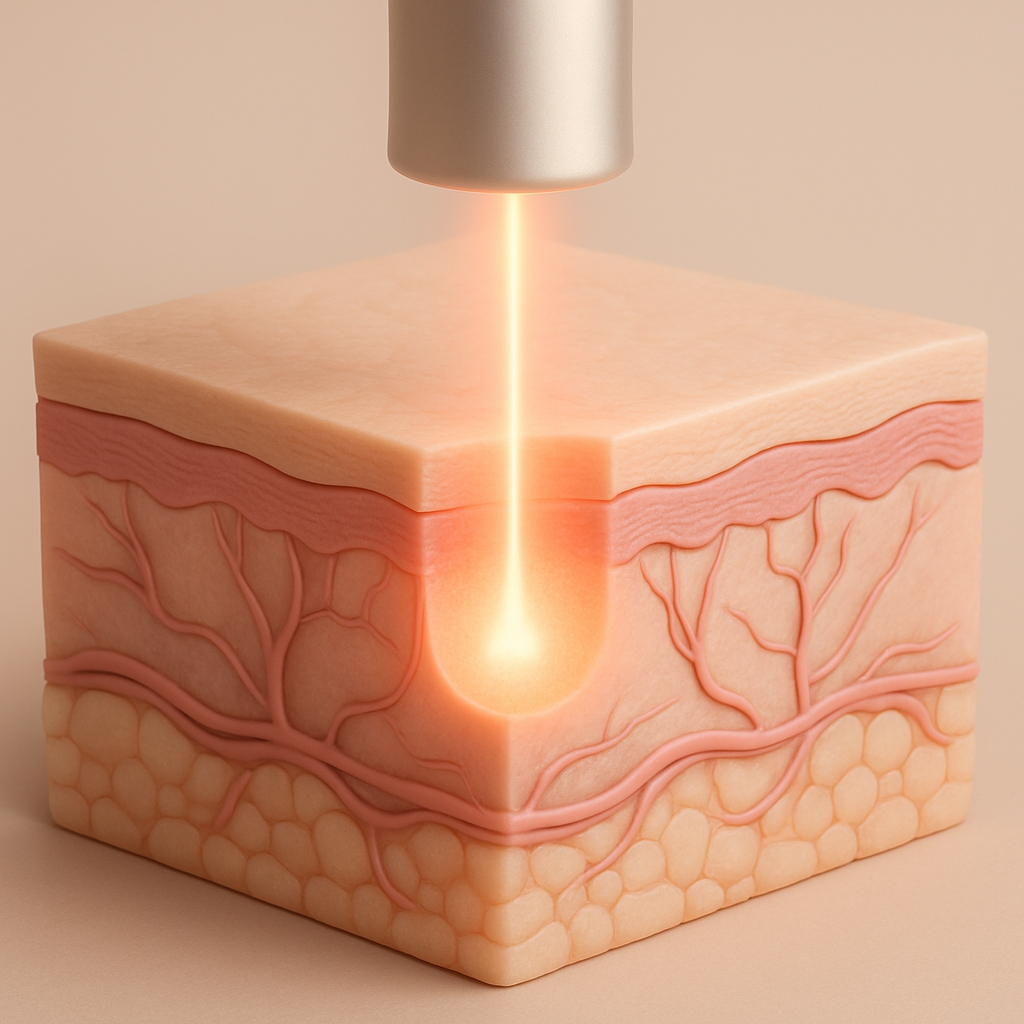
The 0–24 hours immediately after laser treatment is when the most noticeable skin changes appear. Erythema (redness) is observed immediately after the procedure and appears more severely with an ablative laser. Swelling also occurs, so the face may look puffy overall, especially around the eyes and cheeks. If microbleeding occurs, small red dots appear on the skin surface, and in some cases dark bluish bruising may appear. A burning-like heat sensation is also common, caused by stimulation of nerve endings.
From two to three days after the procedure, flaking (exfoliation) begins due to damage to keratinocytes. Those who received an ablative laser experience clearer flaking, and sometimes crust formation is observed. The crust is a defense mechanism that forms naturally to protect the damaged epidermis. Itching can worsen at this stage, but you must never scratch. If itching is hard to bear, it is best to tell your medical staff and get a soothing cream or medication prescribed.
One Week to Two Weeks: Regeneration and Recovery Stage
At this stage, the skin's natural regeneration process proceeds in earnest. Fibroblasts are activated and begin producing extracellular matrix components such as collagen and elastin. This process plays an important role in restoring skin elasticity and radiance. Erythema decreases compared to the first week, but clear redness may still remain. With an ablative laser, the crust begins to fall off naturally, and forcibly removing the crust at this time increases the risks of infection and scar formation.
Swelling also gradually decreases, but additional time is needed for it to disappear completely. This is a period with large individual variation: some people become almost normal after one week, while others may have persistent swelling for more than two weeks. This depends on the individual's skin recovery capacity, sensitivity of the immune response, procedure intensity, and post-procedure care. UV protection and moisturizing care remain essential during this period as well.
Two Weeks to Four Weeks: Pigment Change and Sensitivity Recovery Stage
After four weeks, the acute inflammatory response mostly subsides, and the skin approaches a normal state in appearance. However, inside the skin, collagen regeneration and epidermal re-formation are still in progress. A major change that can appear at this stage is pigmentation (staining). When melanocytes are excessively activated by laser stimulation, brown or gray pigmentation can form on the treated area. This is especially likely in people with darker skin tones or those with heavy sun exposure.
Conversely, some people may experience hypopigmentation, in which the treated area becomes brighter than the original skin. This is a temporary change that occurs as the laser destroys melanin and normalizes over several months in most cases. Skin sensitivity also begins to recover at this stage. Skin that was extremely sensitive initially gradually recovers its tolerance to stimulation. However, full recovery usually takes four to six weeks.
After One Month: Long-Term Skin Changes and Lasting Effects
One month after laser treatment, the visible changes are mostly normalized. Erythema, swelling, and crusting disappear completely, and pigmentation gradually fades. However, collagen regeneration in the dermis continues and can last up to three to six months. In fact, the main effects of laser treatment appear more clearly weeks to months after the procedure than immediately after. Effects such as improved skin elasticity, reduced fine lines, brighter skin tone, and pore reduction appear gradually.
During this period, sunscreen use must be thorough. UV exposure worsens pigmentation, hinders the healing process, and can cause new damage. In addition, adequate moisturizing care helps repair the skin barrier, and using products containing anti-inflammatory ingredients helps calm residual inflammation. In some individuals, pigmentation or redness persists even after six months, in which case you can consult medical staff and consider additional treatment.
Side Effects and Precautions After Laser Treatment
Unlike the acute responses expected after laser treatment, some people may experience side effects. The most common side effect is excessive pigmentation, with a high risk especially in people frequently exposed to sunlight or with darker skin tones. Hypopigmentation is the opposite phenomenon, in which the treated area becomes brighter than the surrounding skin; it is mostly temporary but rarely can persist for a long time. Infection has a high risk when the crust is forcibly removed or managed in an unclean environment, and it can be prevented with antibiotic ointment.
Keloid or hypertrophic scars are serious side effects that can appear in people with a scarring tendency or when a powerful laser is used excessively. Burns occur when the laser's energy is set improperly and can be prevented by following proper techniques and safety protocols. Blister formation can occur when the epidermis is severely damaged after an ablative laser and must be managed according to medical staff's instructions to prevent infection. The risk of these side effects is determined by the individual's skin condition, underlying conditions, procedure technique, and post-procedure care.
Core Principles of Skincare After Laser Treatment
To minimize skin changes and promote healing after laser treatment, systematic care is essential. The first principle is UV protection. Use sunscreen of SPF 50 or higher daily, minimize outings if possible, and also use physical barriers such as a hat and sunglasses. UV can worsen pigmentation, prolong inflammation, and aggravate skin damage.
The second principle is moisturizing care. To repair the damaged skin barrier, use essences, creams, and sheet masks containing moisturizing ingredients such as ceramides, glycerin, panthenol, and centella. In particular, for the first few weeks after the procedure, it is important to avoid irritating products and focus on intensive moisturizing with mild products. The third principle is avoiding irritation. From immediately after the procedure through recovery, avoid irritation such as products containing acids (glycolic acid, salicylic acid, vitamin C), strong peeling products, and excessive rubbing.
The fourth principle is following medical staff's instructions. If you were prescribed medications such as antibiotic ointment, soothing cream, or steroid cream, use them at the exact dose and duration. The fifth principle is infection prevention. When a crust has formed, never forcibly peel it, and be careful not to touch it with your hands or wash it excessively with soap. The sixth principle is adequate hydration and rest. Sufficient sleep and hydration enhance the body's natural healing ability and accelerate the pace of recovery.
Q. When can I wear makeup after laser treatment?
It depends on the type of laser treatment. With a non-ablative laser, there is no visible surface damage, so light makeup may be possible from the day after the procedure once swelling has subsided somewhat. However, with an ablative laser, the epidermis is removed, so makeup should be avoided until full recovery. In general, makeup is possible about one week after the crust has completely fallen off. When wearing makeup, use low-irritation products and cleanse thoroughly in the evening.
Q. Is it normal for swelling to last several days after a laser procedure?
Swelling is a normal inflammatory response, and its degree and duration vary by individual. In general it peaks within 24 hours of the procedure and gradually decreases over three to seven days. However, due to facial structure, it can last more than two weeks around the eyes and cheeks. To relieve swelling quickly, avoid exposure to cold wind, sleep with your head elevated on a high pillow, and use the soothing cream recommended by medical staff.
Q. Why does pigmentation occur after laser treatment?
Pigmentation occurs when melanocytes are excessively activated by the inflammatory response caused by laser stimulation. The risk is especially high in people with darker skin tones, those frequently exposed to sunlight, and those with hormonal changes (such as during pregnancy). Pigmentation is mostly temporary and naturally fades over three to six months with UV protection and time. However, in severe cases, you can consult medical staff and consider additional treatment (brightening cream, vitamin C serum, chemical peel, etc.).
Q. Can I peel off the crust after laser treatment?
You must never forcibly peel off the crust. The crust protects the damaged epidermis and defends against infection. Forcibly removing it increases the risk of bleeding, infection, and scar formation. It is safest to wait until the crust falls off naturally. In general it falls off naturally about 7 to 14 days after the procedure. If the crusted area itches, you can protect and soothe it with antibiotic ointment and panthenol cream.
Q. When can I exercise or use a sauna after laser treatment?
For two weeks immediately after laser treatment, you should avoid activities such as exercise, saunas, jjimjilbangs, and hot baths. These activities increase blood flow, worsening swelling, prolonging inflammation, and raising the risk of infection. Excessive sweating can also irritate the skin and promote bacterial growth. Light walking is possible after a few days, but strenuous exercise is best started only after the recovery period has fully ended (usually four weeks or more).
Notice under Article 56 of the Medical Service Act: This article is intended to provide medical information about skin laser treatment and does not replace diagnosis or prescription. The degree of change and pace of recovery after laser treatment may differ depending on an individual's skin condition, underlying conditions, and medications. If side effects or symptoms different from expected appear, please contact the medical institution where you received the procedure immediately.